
Adventure gamers are generally a conciliatory bunch, unless, of course, holy war topics come up. And one of those topics that often brings out the ire in a group and makes them go full-on 28 Days Later rage haterading is whether parsers, point-and-click mouse mechanics, or FMV-style controls are “better.” I’m purposely keeping it vague, because most of the arguments about these things actually are extremely vague but with concrete examples of why one is “better” than the others. To that point, I don’t think any one of them is better or worse than the others. It comes down to the style of the game, and people who prefer one or the other will either enjoy the game or bitch and moan about it incessantly.
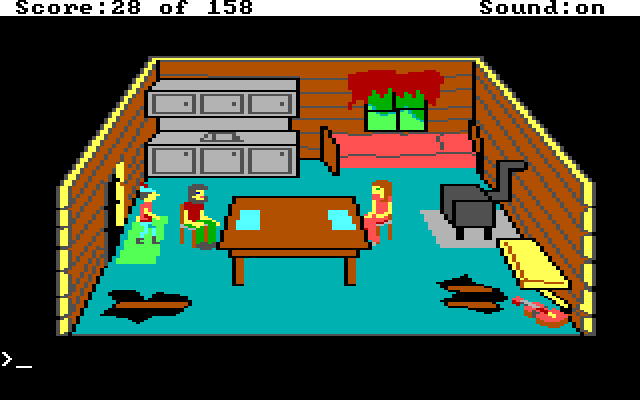
I’m a huge fan of parse games. Since I’m a crotchety old guy, I was playing text adventures way back in the day… and they were quite literally only text and a very limited parser. Infocom made the parser better, but still ran into a large number of “guess the word” scenarios where the designers had specific words in mind, and often players had a different vocabulary. But, because I really loved text adventures, parser games like Treasure Island, King’s Quest, and Eamon were right up my alley. And, as an avid reader, I sometimes had the same or at least thesaurus-parallel vocabularies to some of the game developers out there.
Still, I had a hell of a time with some of the puzzles in the Enchanter trilogy from Infocom as well as the much more limited vocabulary options of the early parser games from Sierra (King’s Quest, Leisure Suit Larry, and Space Quest, I’m looking at you). And, yes, you can play the Enchanter trilogy online:
But even the role-playing games I was playing on the computer at the time had a contingent of keyboard commands, often taking up the entire keyboard even if you only used a single key once in the game to do something like digging. So parser games felt perfectly natural to me. I did have to learn to stop moving at the right time in Sierra games, lest I plummet to my death while trying to type something innocuous into the parser.
When I first played a point and click adventure, it made sense to me as well. I can’t remember the game, but it was played with a joystick because mice weren’t as common-place yet. And so you could choose options similar to a Choose Your Own Adventure book. While it seemed to have more limited options because you couldn’t type whatever you wanted, all of the options were valid and didn’t give an “I don’t know how to do that” error because it had no idea what you just typed in was supposed to do.
And when point-and-click became mouse-centric, I loved it. Sure, it made some games easier, but really, trying to walk to the exact right pixel and type the exact right phrase often felt like an exercise in futility. With my patience where it is now in old man mode, I definitely couldn’t solve most early Sierra games.
I feel the need to put in an honorable mention here to the Sega Master System version of King's Quest. It was developed by Parker Bros for the console and had a kludgy but innovative interaction system using the controller. The player would press a button to start interaction and then select relevant verb noun combinations to perform actions based on the screen they were currently on. It was awkward to be sure, but still one of the first times a computer adventure game tried to make the transition without converting the game into another genre entirely.
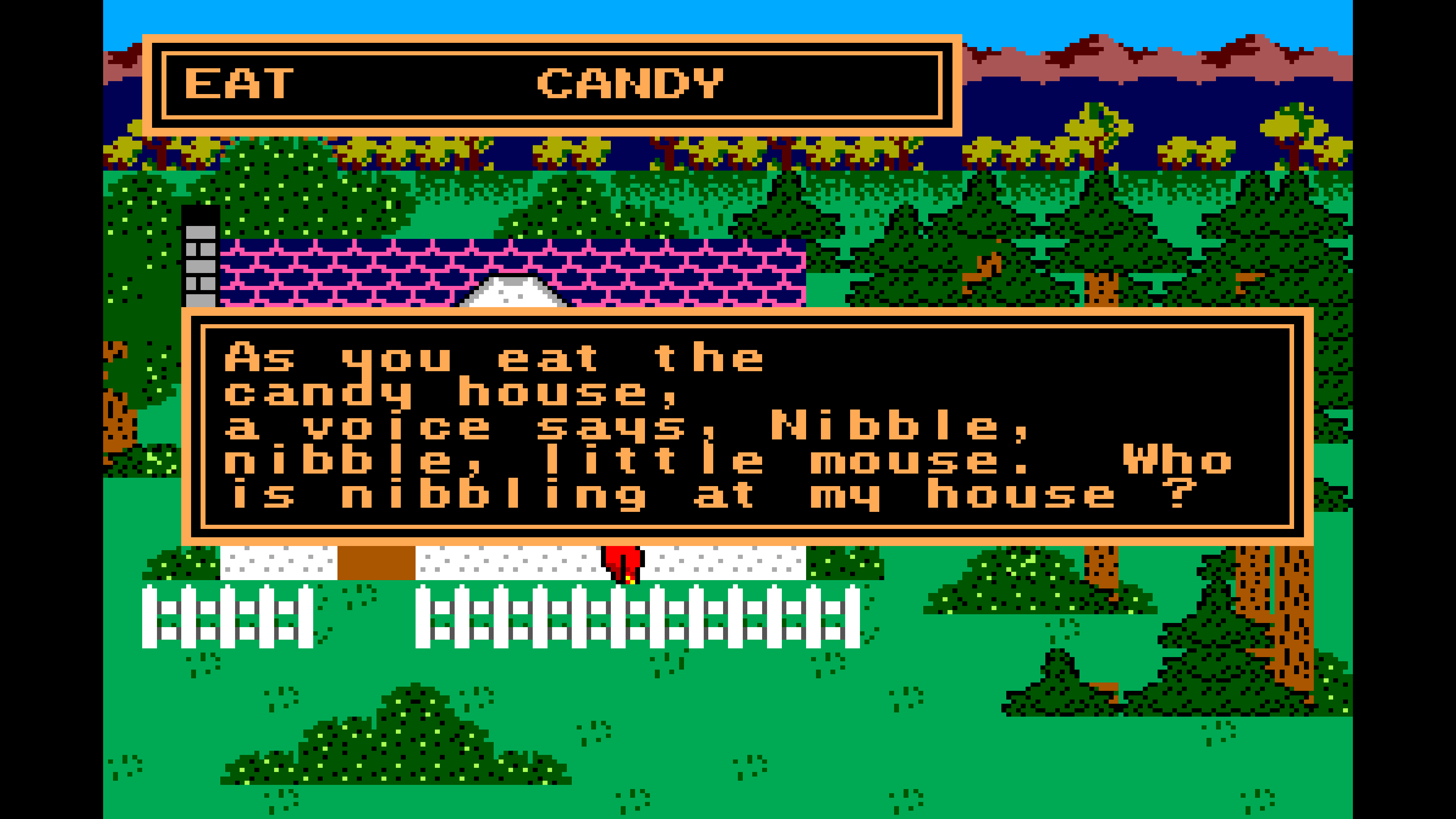
This progression from parser to point-and-click interface is often thought of as dumbing down the interface in some adventure game circles, and the move to FMV often further diminished things since some of the FMV games required even less interface and fewer interactions sandwiched between full motion video sequences.
And yet, I really dug them. I think a lot of that enjoyment came from the idea of playing a movie, which was what many of them were. A video would play, you would make a choice, often something like pushing a button or clicking a door, and then the next video would play until you finished the game. It shouldn’t have worked, and it really did not in the long-term, but it worked for me during the FMV heyday. And some games made better use of interactions and puzzles.
But the FMV simplification combined with the trend towards casual games led, quite naturally, to other adventure genres such as escape room games, hidden object games, and walking simulators. Escape room games are hinged upon solving logic puzzles, and I strongly credit the Myst series for their explosion, even though I do not believe there is a lot of logic in Myst. Luckily, escape games usually have more logic involved.
Hidden Object games take a basic adventure premise, and while mostly linearly navigating the player, offer a number of times where the player has to sift through screens of junk to find the right piece of junk to continue the storyline. It may not sound like it, but I really enjoy hidden object games. These, Match-3, and incrementals are comfort games for me.
Walking simulators are environmental games where the story is often emergent depending on how the player explores the environment. For some, they are inventive creations, and for others, they are really, really slow first-person games. I generally enjoy them, with Gone Home, Dear Esther, and The Vanishing of Ethan Carter being a few of my favorites.
I would also feel a bit remiss if I didn’t mention gaming portals like NewGrounds, itch.io, and Kongregate which allowed developers to upload the games they made, often in Flash, and share them with the world. There are a ton of excellent point-and-click adventure games like the Don’t Sleep trilogy, Cube Escape Collection, and the Zombie Society: Dead Detective games. They’re interesting and often innovative in their limited formats, even if some of the games on those sites are unplayable because of the removal of Flash support. The links I provided are for their Steam pages.
And, of course, as I meandered through these games and topics, I missed out on some major ones like the SCUMM interface titles like Maniac Mansion and The Secret of Monkey Island from LucasArts, the MacVenture series (Shadowgate, Uninvited, Deja-Vu, etc) which made the jump to the Nintendo Entertainment System and cleaned up the interface perfectly. As well as others like the Sorcery! Games, Simon the Sorcerer, Spellcasting 101, Wonderland, and so many more.
But mainly, I just wanted to share some of my experiences with the different styles of user interfaces in adventure game, and why it has never been a holy war topic for me.